
When we think of modern fashion, our minds instantly conjure up images of dazzling runways, avant-garde design studios, blinding camera flashes, and elite boutiques. But if you look closely at the fabric of modern Indian fashion, you won’t find its origins in a glamorous metropolitan studio.
At House of Sivana, we believe that every garment has a soul, and that soul is tied to a history that is as rich as it is rebellious. The true story of Indian fashion didn’t start with a sketch—it started with a spinning wheel, a thread, and a village.
Here is the incredible, untold history of how Indian fashion was born out of resilience, reclaimed by visionary women, and built on the backs of forgotten artisans.
The Thread of Rebellion: Khadi as a Weapon
In the years leading up to and immediately following 1947, clothing in India was not merely a matter of personal style; it was a profound political statement.
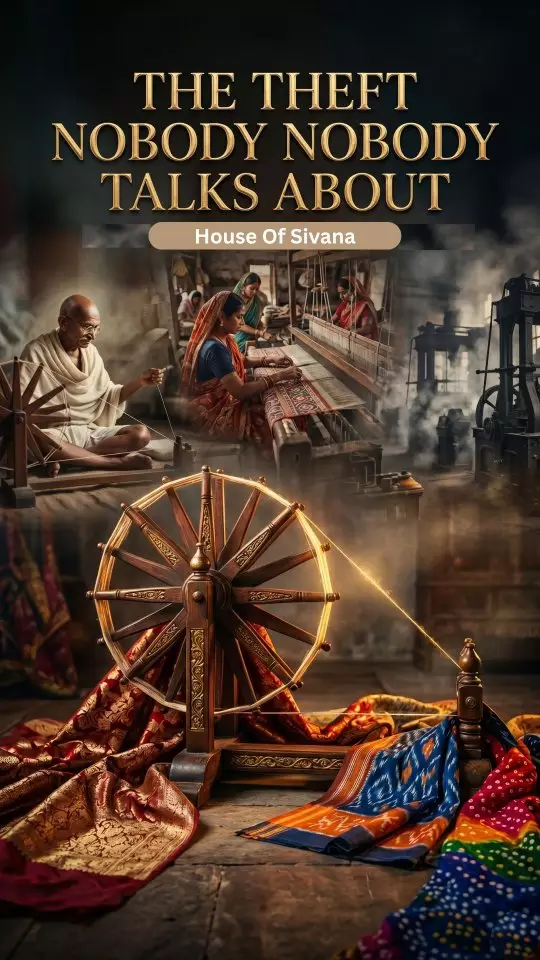
During the colonial era, fashion became a battlefield. Mahatma Gandhi recognized the power of self-reliance and turned Khadi—handspun and handwoven cloth—into a peaceful but potent weapon against colonial rule. The message was simple yet revolutionary: Spin your own cloth. Starve the British mills. By rejecting imported clothes, Indians reclaimed their economic independence and cultural pride.
Following independence, leaders like Jawaharlal Nehru took this sartorial statement to the global stage. By wearing the traditional Achkan and his now-iconic tailored jacket, he signaled to the world what a modern, independent India looked like. At House of Sivana, we draw immense inspiration from this era, recognizing that what we wear is an expression of our identity and our values.
The Great Craft Theft
However, standard history books often skip over a dark chapter of India’s textile journey. For over a hundred years, the British Empire systematically dismantled India’s thriving craft economy.
British colonizers took India’s intricate, indigenous craft designs, shipped them to the heavily industrialized mills of Lancashire, mass-produced them using cheap machine labor, and sold them back to Indians. This economic drain was devastating. The original creators of these beautiful designs—the Indian artisans—were left entirely jobless. Their ancestral skills were forgotten, and their traditional crafts were pushed to the very edge of erasure.
The Women Who Saved Indian Textiles
The survival of India’s textile heritage is owed largely to the relentless efforts of women. In 1952, a cultural renaissance was sparked by two extraordinary visionaries who decided that the erasure of Indian crafts had to end.
Kamaladevi Chattopadhyay took on an impossible mission. She built the All India Handicrafts Board from scratch. Traveling across the dustiest corners of the country, she actively brought ancient textile arts like Kalamkari, Ikat, and Bandhani back from the brink of extinction.
Alongside her, Pupul Jayakar revolutionized the sector by setting up weavers’ training centers across the nation. She gave thousands of artisan families the financial support and the creative reason they needed to stay at their looms. They didn’t have social media campaigns or venture capitalist funding rounds; they had sheer willpower and a deep love for Indian heritage.
The Foundation of Fabric
Because of these efforts, modern Indian fashion was given the foundation it needed to eventually thrive. The true pioneers of our style aren’t modern trend forecasters; they are the generational weavers of Banarasi silk, Kanchipuram, Chanderi, Bandhani, and Ikat. These are not just fabrics. They are historical documents woven in silk and cotton. They are the bedrock upon which the entire modern Indian ethnic and fusion wear industry—including collections curated by House of Sivana—is built.
From a Serampore Village to the First Boutique
The transition from traditional craft to modern retail has its own fascinating pioneer. In the late 1960s, a young art history student named Ritu Kumar walked into the small village of Serampore in West Bengal. What she found was a colony of highly skilled, yet unemployed and forgotten hand-block printers.
Recognizing their immense talent, she began giving them contemporary designs to print on sarees. Because India did not yet have a single fashion retail store, she began selling these artisanal creations out of a humble grocery store. Her success proved the market’s hunger for authentic Indian crafts, leading her to open India’s very first designer boutique in 1969.
Celebrating the Real Makers at House of Sivana
The grand conclusion of Indian fashion history is clear: Indian fashion didn’t begin on a runway. It began in the courtyards of villages no one had ever heard of. It was sustained by the hands of artisans, championed by fierce women, and woven into existence thread by thread.
At House of Sivana, we do not just sell clothing; we celebrate this profound legacy. When you wear a piece that features traditional block prints, intricate embroidery, or handwoven textiles, you are wearing a piece of history. You are honoring the artisans, the women, and the villages that kept the soul of India alive.
Explore our collections at House of Sivana, and join us in wearing our heritage with pride. Because true fashion isn’t just about looking good—it’s about remembering where we came from.