
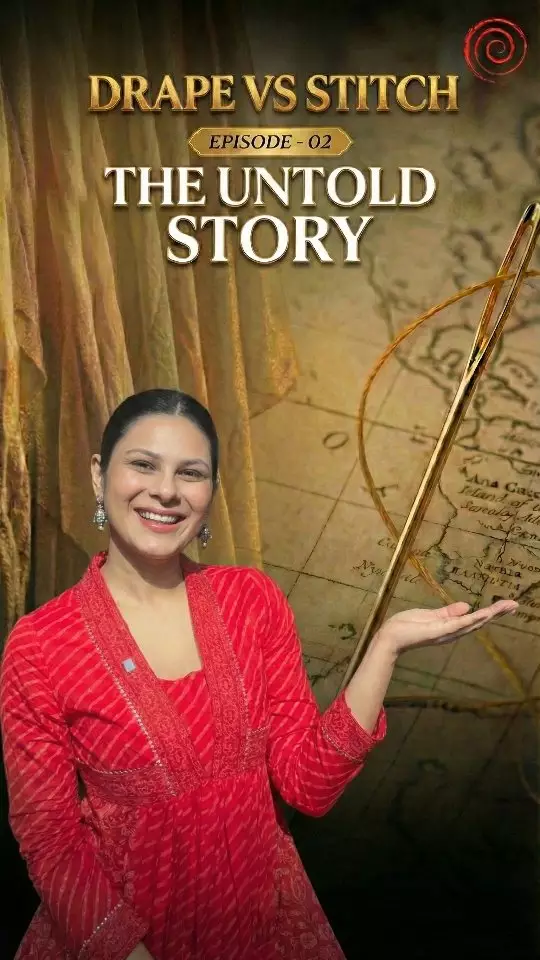
When we visualize the quintessential landscape of Indian fashion, our minds immediately gravitate toward the majestic sweep of a sari, the regal folds of a dhoti, or the intricate layering of a dupatta. For centuries, India has been globally celebrated as the undisputed capital of draped textiles. However, the introduction of stitched clothing to the Indian subcontinent is a fascinating chapter in our sartorial history—one that is often misunderstood.
At House of Sivana, we believe that understanding the origin of our clothing is the key to truly appreciating its artistry. There is a common historical misconception that the arrival of tailoring and stitched garments meant the death of draping. The reality, however, is a beautiful story of coexistence, adaptation, and profound textile intelligence.
The Golden Age of Draping: An Unbeatable Tradition
To understand why stitching took time to permeate the Indian subcontinent, we must first understand why draping was—and remains—so incredibly successful. The answer lies in geography, climate, and culture.
In the intense heat and humidity of the Indian subcontinent, fixed, tight-fitting clothes were simply impractical. Draped garments offered unparalleled breathability, allowing air to circulate freely around the body. Beyond climate, draping held deep cultural and spiritual significance.
Ancient Vedic texts and later scriptures often specified the use of “fresh, uncut cloth” for religious rituals and daily wear. An unstitched garment was viewed as pure and untainted by the piercing of a needle. Furthermore, the unstitched textile championed the concept of a “reuse economy” long before sustainable fashion became a modern buzzword. A single length of cloth lived multiple lives: it could be draped as a sari, repurposed into a baby’s cradle, transformed into a soft quilt (like the traditional Kantha), and eventually used as a household cloth.
The Arrival of the Needle: When Context Demanded Change
If draping was so perfect, why did stitching enter the Indian fashion narrative? As highlighted in the Origin of Indian Fashion series, “stitching didn’t come to India because draping was failing.” It arrived because the context of human life was rapidly shifting.
After the first millennium BCE, the scale of movement across the Indian subcontinent began to surge dramatically. The catalyst wasn’t fashion, but function:
-
The Era of Warfare and Horses: As horses entered warfare, soldiers required clothing that offered mobility and protection. Flowing, draped fabrics were a liability in battle and highly impractical for horseback riding.
-
Long-Distance Travel: As trade routes expanded and travel became common, people needed garments that could withstand the rigors of long journeys without needing constant readjustment.
-
Climatic Shifts: Increased interaction with colder regions and the shifting dynamics of royal courts necessitated clothing that could provide warmth and denote a structured, formal hierarchy.
Through the Northwest frontiers, influenced by Central Asian and Indo-Persian cultures, new forms of clothing began to integrate into Indian society.
The Rise of Functional Fashion: Tunics, Trousers, and Angrakhas
This era marked the moment when “fixed” or stitched clothing became highly useful. The role of cutting and tailoring expanded, offering clear, utilitarian advantages:
-
Trousers for Stability: Tailored trousers provided the necessary friction and stability required for horseback riding, entirely changing cavalry dynamics.
-
Weight Distribution: Garments like tunics and the traditional Angrakha (a crossover tunic tied at the side) were engineered to distribute the weight of the fabric evenly across the shoulders and torso.
-
Layering for Climate Control: Stitched pieces allowed for systematic layering, which was essential for survival and comfort in colder climates.
The Myth of Replacement: A Harmonious Coexistence
One of the greatest misreadings of fashion history is the assumption that the arrival of the needle and thread rendered the unstitched cloth obsolete. History is rarely a simple story of replacement; it is usually a story of addition.
Stitching and draping did not compete for dominance; they coexisted perfectly. While stitched garments became the uniform of the courts, the cavalry, and the cold, draped garments remained the undefeated champions of the hot, humid Indian summers and the sacred spaces of daily rituals.
Draping as “Generalized Intelligence” vs. Stitching as “Specialized Clothing”
Perhaps the most profound way to view this historical evolution is through the lens of functionality.
Stitching creates specialized clothing. A pair of trousers is meant to be a pair of trousers. It is tailored for a specific body, a specific size, and a specific function.
Draping, on the other hand, is generalized intelligence. A single six-yard textile possesses the “intelligence” to adapt to any body type, any size, any age, and any gender. It fluctuates with the wearer, accommodating weight changes, pregnancies, and differing levels of mobility. It is the ultimate adaptive technology.
Different systems of dress coexisted, and which system was activated depended entirely on the context of the wearer’s life on any given day. Cutting mattered, and stitching revolutionized utility, but domination was never the goal.
The House of Sivana Perspective
At House of Sivana, our collections are deeply inspired by this historical duality. We honor the “generalized intelligence” of traditional Indian draping while celebrating the structured elegance and specialized utility of stitched silhouettes.
Indian fashion is not a straight line from unstitched to stitched; it is a rich, interwoven tapestry where both forms elevate one another. Whether you are slipping into a sharply tailored tunic or wrapping yourself in the fluid grace of an unstitched drape, you are participating in a millennia-old conversation between the needle and the loom.
Discover the perfect balance of heritage and modern utility with House of Sivana’s latest collections—where history is always in style.